
Last Updated: October 23, 2026
Quick Summary
The best vehicle types for moving large furniture are cargo vans for apartment moves, box trucks for whole-home moves, and pickups or SUVs for short trips with one or two pieces. The item's dimensions and weight decide the vehicle, so measure the longest dimension, diagonal depth, and weight before booking.
- A standard cargo van's cargo area runs roughly 10 to 12 feet long and 6 feet wide.
- A 10-foot box truck is the smallest option that lets you stand up while loading.
- Pickup beds run about 5.5 to 8 feet, and a full-size sofa usually overhangs the tailgate.
- Put heavy items like dressers on the floor, over or ahead of the rear axle.
- Use a delivery service when the piece weighs more than about 300 pounds.
Table of Contents
- Quick Comparison: Vehicle Types for Moving Large Furniture
- Moving Truck Sizes for Furniture: What Fits Where
- Pickup Trucks and SUVs: Open-Bed Limits and Interior Space
- How to Transport a Couch Without Damage
- Payload, Weight Limits, and Safe Loading
- Moving Furniture from Facebook Marketplace: Vehicle Picks
- Furniture Delivery Services vs. DIY Vehicle Rental
- Conclusion
- Frequently Asked Questions
Quick Comparison: Vehicle Types for Moving Large Furniture
Moving large furniture is mostly a math problem. The best vehicle types for moving large furniture are cargo vans for apartments, box trucks for whole-home moves, and pickups or SUVs for short trips with one or two pieces.
Below, we break down each option by what actually fits, what it costs to rent, and when hiring help beats driving yourself. The Federal Motor Carrier Safety Administration guidance on cargo securement is worth reading before you tie anything down.
| Vehicle | Best For | Typical Cargo Length | Main Limitation |
|---|---|---|---|
| Cargo van | Apartment moves, one large item | About 10-12 ft | Low roof on standard models |
| Box truck | Full apartment or office | 10-26 ft | Needs space to park and turn |
| Pickup truck | One or two items, short trips | 5-8 ft bed | Open bed, weather exposure |
| Large SUV | Small furniture, short hauls | 6-8 ft with seats down | Height and door clearance |
| Sedan | Boxes and small items only | Trunk only | No large furniture |
Moving Truck Sizes for Furniture: What Fits Where
Matching truck size to furniture is the step most people skip, and it is why so many rentals end with a scratched dresser and a wasted afternoon. Stop thinking in vehicle labels and start thinking in three numbers: longest dimension, diagonal depth, and weight.
The three measurements that decide the vehicle
Before you book anything, record these for every large piece:
- Longest dimension, the sofa back, the wardrobe height, the mattress length. This is what determines whether the item fits along the cargo floor or must go in diagonally.
- Diagonal depth, the distance from front-bottom corner to back-top corner. A 7-foot sofa that is 3 feet deep needs more than 7 feet of floor if it cannot stand on end; the diagonal is what actually clears the door and the wheel wells.
- Weight, the number that decides whether the vehicle can legally and safely carry the item at all (more on payload below).
People often measure only the longest dimension, rent a vehicle that fits it on paper, then discover the item will not clear the wheel wells or rear door. Measure the door opening too, a standard cargo van rear door is roughly 4 to 4.5 feet wide and 4 to 5 feet tall on low-roof models.
Cargo Vans: The Sweet Spot for Apartments
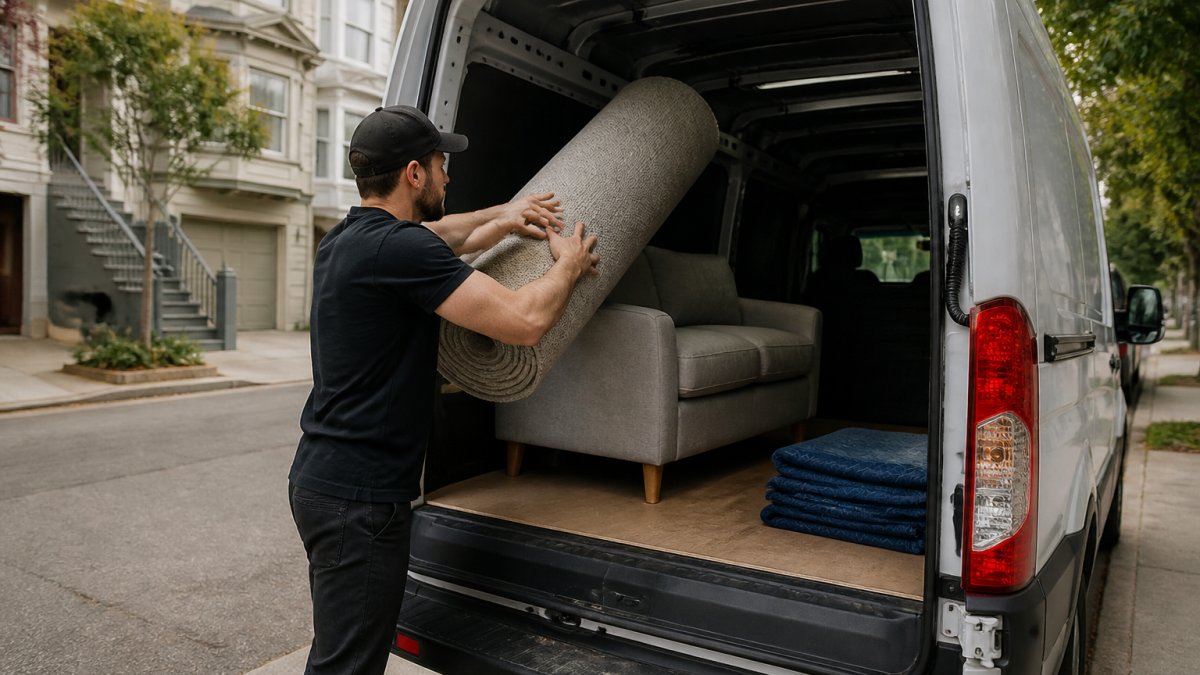
A standard cargo van handles most one-bedroom apartment moves.
The low roof is the catch: standard vans force you to load tall dressers and wardrobes on their side, so pad the corners first. High-roof Sprinters solve this but cost more.
Box Trucks: When You Have a Whole Apartment
A 10-foot box truck is the smallest option that lets you stand up while loading, and it swallows a studio or small one-bedroom in a single trip.
The trade-off is maneuverability and parking: a box truck needs turn clearance and a loading zone a van does not. If your building has a tight garage or narrow alley, measure before you book.
Furniture-by-furniture fit matrix
Use this as a starting point, then confirm against the actual vehicle's interior dimensions. "Fits" means it fits without disassembly; "disassemble" means legs, cushions, or connectors must come off; "no" means choose a larger vehicle.
| Furniture item | Cargo van (10-12 ft) | 10-ft box truck | 15-16 ft box truck | Pickup (6.5-ft bed) | Large SUV (seats down) |
|---|---|---|---|---|---|
| Two-seat loveseat (up to 5 ft) | Fits | Fits | Fits | Fits, tailgate down | Fits |
| Three-seat sofa (7-8 ft) | Fits up to ~7 ft; longer needs diagonal | Fits | Fits | Overhangs; strap and flag | No |
| Sectional (3+ pieces) | Disassemble; tight | Fits disassembled | Fits | No | No |
| Queen mattress + box spring | Fits on edge | Fits flat | Fits flat | One piece only | Mattress only |
| King mattress + box spring | Tight; box spring may not clear roof | Fits | Fits | No | No |
| Tall wardrobe (6.5-7 ft) | Lay on side; pad corners | Fits upright | Fits upright | No | No |
| Dresser (5-6 ft wide) | Fits | Fits | Fits | Fits | Fits if door clears |
| Dining table (seats 6) | Disassemble legs | Fits disassembled | Fits | Fits disassembled | No |
| Piano (upright) | No | No | Fits with ramp and help | No | No |
Two patterns stand out. The cargo van is a common vehicle that handles a full one-bedroom's large pieces in one trip without disassembly, which is why it is often chosen for apartment moves. And the pickup's 6.5-foot bed is the most overestimated: a three-seat sofa overhangs the tailgate.
When to size up
Size up one tier when the item's diagonal depth exceeds the vehicle's interior width, you have more than one large piece, stairs or an elevator limit how you can angle the load, or furniture plus passengers approaches the payload limit. Sizing up costs a little more at the counter; sizing down costs a second trip, a damaged item, or both.
Pickup Trucks and SUVs: Open-Bed Limits and Interior Space
Pickups and SUVs work for short local trips with one or two pieces, but each has a hard limit worth knowing before you commit.
Pickup trucks carry a bed of about 5.5 to 8 feet, which fits a loveseat, dresser, or mattress, but a full-size sofa usually overhangs the tailgate. An open bed means rain and theft risk, so bring tarps and straps and keep someone with the load at every stop. A half-ton truck handles around 1,500 to 2,000 pounds.
Large SUVs with the second and third rows folded give roughly 6 to 8 feet of flat floor length, and they keep furniture dry and locked, their real advantage. The limitation is height and door opening: a tall bookcase often will not clear the liftgate.
Sedans and small cars are for boxes, lamps, and cushions only. Do not attempt a couch.
How to Transport a Couch Without Damage
Knowing how to transport a couch is mostly about preparation. Five steps separate a clean delivery from a torn cushion.
- Measure twice. Record the couch's length, depth, and height, then measure every doorway, hallway, stairwell, and elevator you will pass through.
- Wrap the corners. Moving blankets and stretch wrap protect fabric and wood frames. Tape the wrap to itself, never to the upholstery.
- Remove what comes off. Legs, cushions, and sectional connectors come off and travel separately in labeled bags.
- Load it standing or on its back. Never rest a sofa on its arms, which bend under weight.
- Strap it down. A couch that shifts during a turn becomes a projectile.
Payload, Weight Limits, and Safe Loading
Payload is the maximum weight a vehicle can carry, including passengers, and exceeding it is a safety problem, not just a handling annoyance. Find the gross vehicle weight rating and curb weight on the door jamb sticker; subtract curb weight from GVWR for your real payload.
A few loading rules that prevent most damage:
- Put heavy items like dressers and appliances on the floor, over or ahead of the rear axle.
- Load tall, heavy pieces against the front wall of the cargo area.
- Distribute weight evenly left to right so the vehicle does not lean.
The Occupational Safety and Health Administration guidance on safe lifting is written for workplaces, but the mechanics apply to anyone lifting a dresser.
Moving Furniture from Facebook Marketplace: Vehicle Picks
Buying secondhand changes the calculation because you rarely know the exact dimensions until you arrive. For moving furniture from Facebook Marketplace, a cargo van is the safest default: it handles almost any single piece, keeps it dry, and leaves room to maneuver.
Our advice for marketplace pickups:
- Ask the seller for photos with a tape measure in frame before you commit to a vehicle.
- Confirm whether the item is on an upper floor and whether there is an elevator.
- Bring blankets, straps, and a friend. Sellers rarely help load.
That last point is where Curbside Movers fits. Our app lets you book background-checked professionals for a single furniture pickup, with transparent upfront pricing and $0 down to book.
Furniture Delivery Services vs. DIY Vehicle Rental
The DIY-versus-hire decision comes down to total cost and total risk, and the only honest comparison adds up every line item on the DIY side, not just the sticker rate. Most people compare the rental rate to a delivery quote and conclude DIY is cheaper; run the full math and the gap narrows fast.
The real cost of a DIY rental
A rental rate is the starting point, not the total. Build your estimate around these line items:
- Base rental rate, per day or per hour; the day rate usually makes more sense because loading always runs long.
- Mileage, many rentals include an allowance and charge per mile beyond it; longer moves exceed it.
- Fuel, return the vehicle full; a box truck burns noticeably more than a van.
The add-ons and the second trip (because the first vehicle was too small) blow the DIY budget, not the base rate.
The real cost of a delivery service
A delivery or moving-labor service quotes a single upfront price bundling the vehicle, labor, blankets and straps, item insurance, and coordination. The trade-offs are scheduling, you book a window, and a minimum charge that can make a single small item uneconomical. For a large or awkward piece, the bundled price is often competitive with the all-in DIY number.
Side-by-side comparison
| Factor | DIY rental | Delivery service |
|---|---|---|
| Upfront cost | Lower on paper | Quoted upfront, all-in |
| Hidden costs | Fuel, insurance, supplies, second trip | None when pricing is transparent |
| Time commitment | Half a day or more | Scheduled window |
| Damage risk | On you | Handled by the provider |
| Physical risk | On you and whoever you recruit | Handled by trained labor |
| Best for | Light loads, short trips, tight budgets | Heavy, awkward, or time-sensitive pieces |
A simple decision rule
Use DIY when the item is light enough for two people to carry, fits the smallest vehicle that can legally carry it, and one round trip covers the trip. Use a delivery service when the piece weighs more than about 300 pounds, is a sectional or piano, requires disassembly and reassembly, involves stairs or a tight doorway, or the seller will not help load.
Conclusion
The hardest part of moving furniture is not the driving. It is the measuring, lifting, and coordination that happens before the vehicle ever moves.
If you would rather skip the rental counter entirely, Curbside Movers books background-checked professionals through our app in minutes, with transparent pricing, no hidden fees, and $0 down. We handle apartment moves, single furniture pickups, and last-minute jobs with the same care.
Frequently Asked Questions
What type of vehicle is best for moving a couch?
A cargo van is usually the best choice for a single couch. Most standard sofas measure 84 to 90 inches long, and a full-size cargo van offers roughly 10 to 12 feet of load length, so the couch fits flat with room for cushions and a coffee table. A pickup truck works if you have tie-downs and a dry day, but an open bed exposes fabric to rain and road grime. For oversized sectionals, step up to a 15-foot box truck.
Can a couch fit in a cargo van?
Yes, in most cases. A standard three-seat sofa fits in a full-size cargo van when loaded on its side or standing on end. Measure the couch's longest dimension and compare it to the van's interior length, which is typically 10 to 12 feet on full-size models. Compact cargo vans usually top out around 8 feet of load length, so they suit loveseats and armchairs rather than full sofas. Bring a tape measure to the rental counter.
How do you move large furniture from Facebook Marketplace?
Measure the item before you commit to buying, and confirm door widths and hallway turns at both pickup and drop-off. For a single dresser or table, a pickup truck or small cargo van handles it. For multiple pieces or a sectional, book a furniture delivery service instead of renting a truck, since you avoid rental paperwork, fuel, and the return trip. On-demand movers can often pick up the same day, which matters when a Marketplace seller needs the item gone quickly.
Should I rent a truck or hire movers to pick up furniture?
Rent a truck when you have help, flexible time, and only one or two items within a short distance. Hire movers when the item is heavy, your building has stairs or elevator rules, or your schedule is tight. Rental costs add up once you factor in fuel, insurance, mileage, and the return trip, and you still do the lifting. A delivery service bundles labor, transport, and insurance into one quoted price, which is easier to budget for a single Marketplace pickup.
