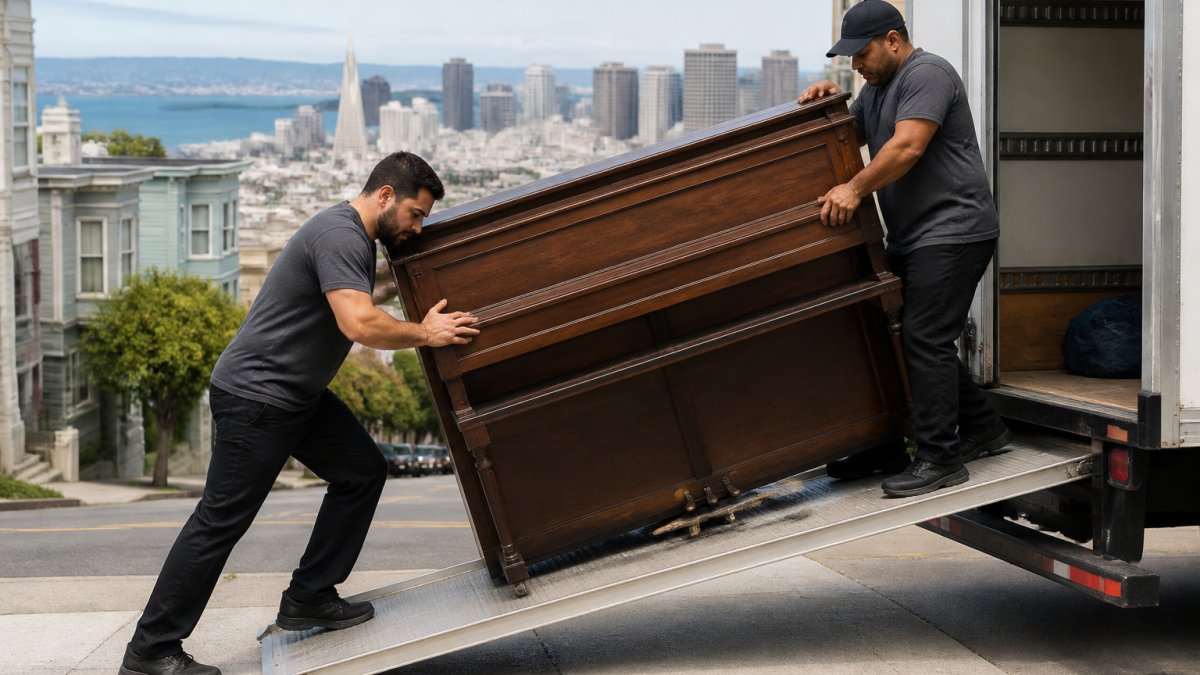
Table of Contents
- Before You Lift: Assessing and Preparing Heavy Items
- Moving Heavy Furniture Up Stairs Safely
- How to Move a Couch Through a Doorway
- Furniture Moving Straps and Other Gear That Helps
- Labor-Only Movers for Heavy Items: When to Book Help
- Building, Street, and Elevator Logistics for a Heavy Item Move
- What Moving Heavy Items in San Francisco Costs
- Frequently Asked Questions
Last Updated: October 17, 2026
Before You Lift: Assessing and Preparing Heavy Items
Moving heavy items in San Francisco starts with an honest assessment, not a brave one. Most injuries and damaged walls happen because someone guessed a piece was lighter than it was.
How to Tell If a Piece Is Too Heavy to Move Yourself
A good rule: if you cannot tilt the item onto a dolly alone without straining, it is too heavy to carry solo. Weight is only part of the equation. Bulk, awkward grip points, and glass panels matter just as much as pounds.
Run through this checklist before you touch anything:
- Can you lift one end and hold it for ten seconds without shaking?
- Does the piece have handles, legs, or edges you can actually grip?
- Is the path at least as wide as the item plus your knuckles?
- Are there turns, thresholds, or half-steps between here and the truck?
- Is the item fragile, glass-fronted, or older than your lease?
Any "no" means you need a second person or a different tool. Two "no" answers mean you should book help.
Preparation matters as much as muscle. Empty every drawer and shelf, remove legs and hardware where possible, tape doors and drawers shut, and wrap corners with moving blankets.
Moving Heavy Furniture Up Stairs Safely
Stair carries are where most accidents happen, and the fix is mostly technique. The person at the bottom carries more of the weight and controls the pace.
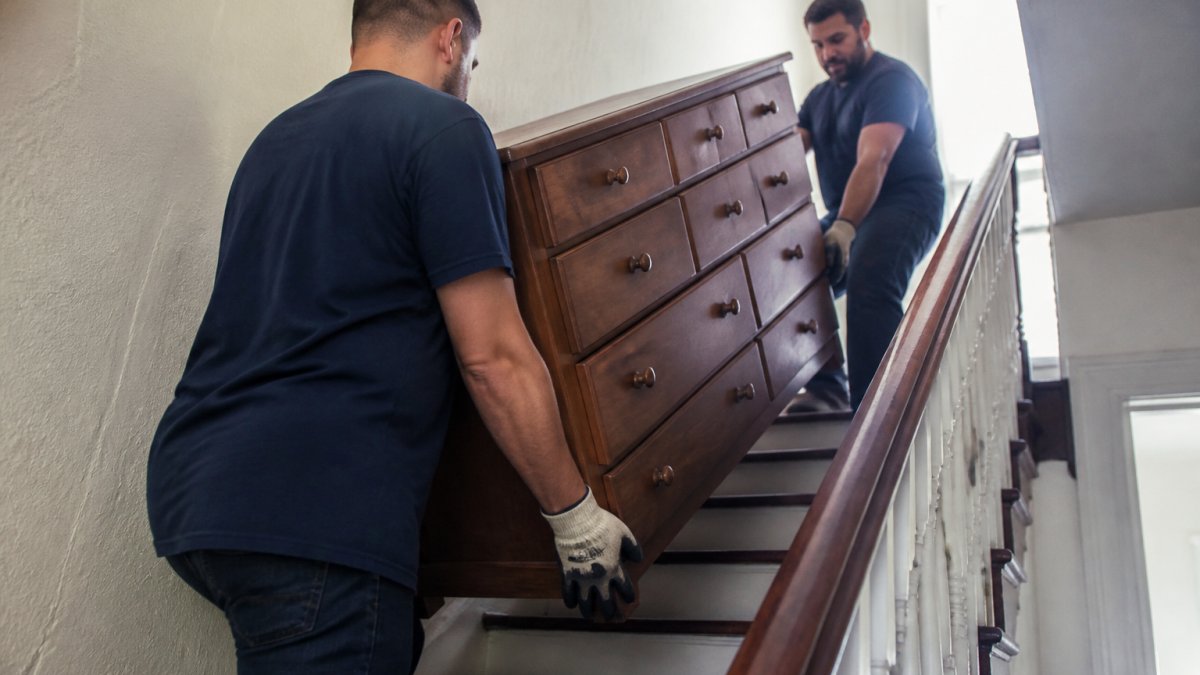
Stair Carries and Tight Landings
Landings are the hardest part of any stair carry. You cannot pivot a couch or dresser in a tight landing the way you would on open floor. Set the item down on the landing, reposition your grip, then lift again.
A few habits that make stairs safer:
- Keep the load close to your body, not out at arm's length
- Bend at the knees, keep your back straight, and lift with your legs
- Communicate constantly: "step," "hold," "down," "up"
- Never twist while carrying weight, turn your feet instead
- Take breaks on landings rather than pushing through fatigue
For anything wider than a standard doorway or heavier than two people can safely manage, a professional crew with straps and a stair dolly is the better call.
How to Move a Couch Through a Doorway
The doorway is usually not the problem. The turn in the hallway before it is. Measure the couch at its widest point, then measure the door frame and the hallway width. If the couch is wider than the hallway, you need to stand it on end before the turn.
A standard approach for moving a couch through a doorway:
- Remove the legs and any detachable cushions
- Stand the couch on its end so the longest dimension runs vertical
- Walk it through the frame one end first, keeping the base clear of the threshold
- Rotate only after the front half clears the frame
- Set it down on a blanket before repositioning for the next turn
If the couch will not fit even on end, check whether the door hinges can be removed. A door that comes off its hinges adds several inches of clearance. On older San Francisco buildings, this is often the difference between a clean exit and a stuck couch.
Furniture Moving Straps and Other Gear That Helps
Furniture moving straps are the single best investment for anyone hauling heavy pieces. A good forearm strap set lets two people carry a dresser or couch with their hands free for doorways and railings, and it shifts the load to your larger muscle groups instead of your lower back.
Gear worth having on hand:
- Forearm lifting straps: two-person carries of bulky furniture
- A furniture dolly or hand truck: anything with a flat base and no stairs
- Moving blankets: protect corners, floors, and door frames
- Stretch wrap: keeps drawers, doors, and cushions from opening mid-carry
- Sliders or a furniture sled: short moves across smooth floors
- Work gloves with grip: sweaty hands drop things
What most guides miss: straps only help if both people know how to use them. Practice the lift once in an open room before you try it in a stairwell.
Labor-Only Movers for Heavy Items: When to Book Help
Labor-only movers for heavy items make sense when you already have a truck, a storage unit, or a rental van and just need hands. You load, they carry, and you avoid paying for transportation you do not need.
Book labor-only help when:
- The item will not fit through a doorway or up a stairwell with two people
- You have a tight move-in window and cannot afford a slow, careful solo attempt
- The piece is fragile, antique, or has glass panels
- You are moving a single heavy item and do not want to rent a truck
- You have an injury, a bad back, or no one to call
At Curbside Movers, we built our app around exactly this kind of job: a Facebook Marketplace couch, a single dresser, a last-minute pickup. You book background-checked professionals in minutes with $0 down, and the price you see in the app is the price you pay, with transparent, upfront pricing, no hidden fees, ever.
If you are weighing a one-item move against a full-service move, the decision usually comes down to whether you need transportation. Labor-only help covers the lifting. A full moving crew covers the truck, the loading, the drive, and the unloading.
Building, Street, and Elevator Logistics for a Heavy Item Move
San Francisco buildings add a layer most moving guides ignore. Many apartment buildings require a certificate of insurance before movers can enter, restrict moves to certain hours, and require an elevator reservation.
Elevator reservations and move windows
Freight elevator bookings are usually handled by the building manager or the front desk, not the leasing office.
Certificate of insurance (COI)
Most buildings that require a COI want to be named as an additional insured, and they want the certificate emailed directly from the mover's insurance agent, not forwarded by you.
Street parking and loading zones
A moving truck needs a legal place to stop. The San Francisco Municipal Transportation Agency (SFMTA) issues these through its temporary no-parking permit process, and the application generally needs to be filed several business days ahead (Temporary Signage).
Long carries and curb-to-door distance
Measure the walk from the nearest legal truck parking spot to your door, including any stairs at the entrance, hallway turns, and the lobby.
Older buildings and pinch points
Walk the full route before move day and note every pinch point: narrow stairwells, low door frames, tight turns at the top of landings, radiators that block the natural path, and any door that opens the wrong way.
The single biggest cause of a delayed heavy-item move is a missing elevator reservation or insurance certificate. Confirm both with your building at least a week out, and get the COI sent directly from the mover's agent to the building.
What Moving Heavy Items in San Francisco Costs
Pricing for moving heavy items depends on several factors, and any honest quote reflects them. Expect the total to move with crew size, the number of stairs, floor level, distance from truck to door, and how long the job actually takes.
How local movers structure a heavy-item quote
Most local movers price by the hour with a minimum, commonly a two- or three-hour minimum for a small job, and then bill in increments after that.
The factors that drive the number
| Factor | Why It Matters |
|---|---|
| Crew size | Two people for most furniture, three for oversized or stair-heavy jobs |
| Hourly minimum | Small jobs still pay the minimum, so batch errands into one booking |
| Stairs and floor level | Each flight adds time and effort; walk-ups cost more than elevator buildings |
| Distance from truck to door | Long carries and tight parking add labor time |
| Item weight and bulk | Heavier and bulkier pieces take longer to handle safely |
| Elevator access | A working freight elevator cuts time significantly |
| Specialty items | Pianos, safes, gun safes, and glass-fronted pieces often carry a surcharge |
| Time of booking | Last-minute and weekend slots can cost more |
What a realistic range looks like
Pricing for a single heavy item moved locally with a two-person crew, or a stair-heavy or oversized piece that needs a three-person crew and specialty handling, depends on several factors.
Fees to ask about before you book
- Stair fee: some movers charge per flight; others build stairs into the hourly time. Ask which.
- Long-carry fee: charged when the truck cannot park close to the door.
- Specialty-item surcharge: pianos, safes, and fragile antiques.
- Truck fee: applies to full-service moves, not labor-only bookings.
- After-hours or weekend premium: common for evening and Sunday slots.
- Payment method fee: some companies charge extra for credit cards.
How to control the cost
The best way to control cost is to prepare: empty the furniture, clear the path, reserve the elevator, and have everything staged near the door before the crew arrives. If you are moving a single item, book labor-only help and skip the truck fee entirely.
For current rates, check the Curbside Movers pricing page or get an instant quote in the app. We show the full price up front, and we do not add fees after the fact.
Bay Area residents moving a single heavy item, a Marketplace find, or a small apartment who want upfront pricing and fast booking without a full-service contract.
Frequently Asked Questions
How do you move heavy furniture without scratching the floor?
Clear the path first, then protect the floor before anything moves. Felt pads or moving blankets under legs reduce drag, and furniture sliders work well on hardwood and tile. On carpet, a sheet or blanket underneath lets you slide instead of lift. Lift rather than drag when crossing thresholds, and keep straps or a dolly under the piece so weight stays off the floor. If a piece is too bulky for one person, book labor-only movers for heavy items so two trained people carry it instead of one person dragging it.
Should you hire movers for one heavy item?
Often, yes. A single bulky item, like a sofa, dresser, or treadmill, is the most common reason people book labor-only movers for heavy items. Two people with straps and a dolly move it faster and with less risk of injury or wall damage than one person improvising. Pricing depends on the item, floor level, number of stairs, and distance, so check the Curbside Movers pricing page or app for a quote before you decide to go it alone.
How do you move a heavy item through a narrow doorway?
Measure the doorway and the item's widest point before you lift. Remove doors from their hinges and take off legs, cushions, or hardware to shave off inches. Tilt the piece so its narrowest profile faces the opening, and have one person guide from the far side. If the item still won't clear, moving heavy furniture up stairs or through a tight hallway may need a two-person crew with straps and a furniture dolly.
How do you prepare an apartment elevator for moving furniture?
Reserve the elevator with your building ahead of time, since many San Francisco buildings enforce move-in windows. Pad the elevator walls and door tracks with moving blankets, and place a mat on the floor. Measure the cab's height and door width against your largest item before the crew arrives. Confirm loading dock or service entrance access and any certificate of insurance your building requires. Curbside Movers can coordinate elevator reservations and building logistics when you book.
Heavy items are where DIY moves go wrong, and where a little planning pays off most. If you would rather hand the lifting to someone else, Curbside Movers makes it simple: book background-checked professionals in minutes through our app, see transparent pricing with no hidden fees, and pay $0 down to reserve your slot. Our team has 15 years of Bay Area moving experience and a 5.0 rating on Google Reviews. Get a quote and let us handle the heavy part.